
AI Scare Trade: How U.S. Markets Are Reacting to AI Disruption Fears
Artificial intelligence has been one of the biggest growth themes in global markets. But now, something different is happening. Instead of excitement, investors are showing fear. This shift is being called the AI Scare Trade — a market reaction driven by concerns that AI could disrupt existing business models faster than expected.
The impact is not limited to technology stocks. The AI Scare Trade is spreading across software, financial services, private credit, and even real estate.
Let’s break it down clearly.
Table of Contents
- What Is the AI Scare Trade?
- Software Sector Under Pressure
- Financial Services Feeling the Heat
- Private Credit Exposure Risk
- Why Real Estate Stocks Are Falling
- Is the AI Scare Trade an Overreaction?
- AI Market Selloff Intensifies Across Sectors
- Final Thoughts
1. What Is the AI Scare Trade?
The AI Scare Trade refers to a wave of selling in U.S. markets driven by fears that artificial intelligence will rapidly disrupt traditional industries.
For years, AI was viewed as a growth driver. Companies integrating AI saw higher valuations. However, investors are now reassessing risk. Instead of asking “Who benefits from AI?”, the question has shifted to “Who gets replaced by AI?”
This shift in psychology is driving volatility.
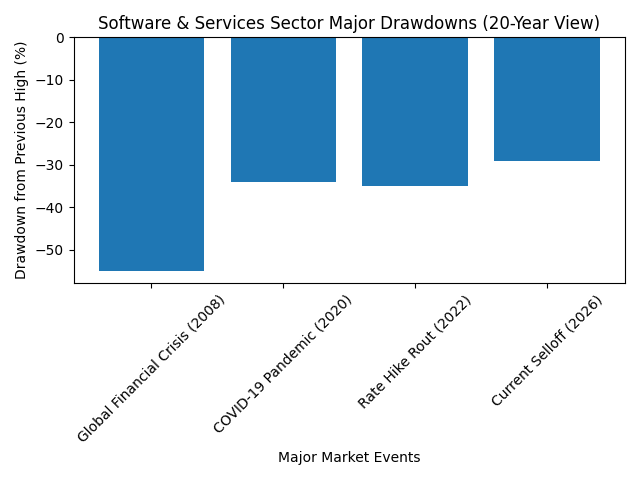
According to recent reporting by Reuters, U.S. software stocks have seen significant declines from their October peaks as concerns around AI disruption grow.
(Source: https://www.reuters.com/
2. Software Sector Under Pressure
The software industry has been at the center of the AI Scare Trade.
Many SaaS companies operate on subscription-based revenue models. The concern is that AI tools could reduce the need for certain software layers, automation tools, or analytics platforms.
Several well-known companies have experienced sharp corrections in 2026. Investors are pricing in the possibility that AI-native solutions may replace legacy systems.
The S&P 500 Software & Services index has lost substantial market value since its peak, reflecting this shift in sentiment.
However, it’s important to understand that this is largely driven by expectations, not confirmed revenue collapses.
3. Financial Services Feeling the Heat
The AI Scare Trade has also impacted financial services.
Brokerage firms and advisory businesses rely heavily on human-driven research, data interpretation, and financial modeling. AI tools are increasingly capable of performing many of these tasks.
As a result, investors are reassessing the long-term profitability of traditional advisory models.
Data providers and analytics firms are also under scrutiny. If AI can generate financial analysis instantly, the value proposition of premium data subscriptions may face pressure.
This does not mean these companies are collapsing. It simply means investors are recalibrating growth expectations.
4. Private Credit Exposure Risk
Another concern linked to the AI Scare Trade involves private credit markets.
A meaningful portion of private lending exposure is tied to technology and software firms. If valuations fall significantly, credit risk could rise.
Alternative asset managers with exposure to software-backed loans have seen increased volatility in their stock prices. Markets are anticipating risk, even before any large-scale defaults occur.
This is how fear spreads — from equity to credit markets.
5. Why Real Estate Stocks Are Falling
One of the most surprising effects of the AI Scare Trade is its impact on commercial real estate services companies.
Firms that provide brokerage, advisory, and property management services depend on human expertise and transaction-driven revenue.
Investors are questioning whether AI-powered analytics, automated valuation tools, and digital deal platforms could reduce dependency on traditional intermediaries.
Major commercial real estate service providers have seen stock price declines as part of this broader fear cycle.
However, real estate transactions still rely heavily on relationships, negotiation, and regulatory compliance — areas where AI adoption will likely take time.
6. Is the AI Scare Trade an Overreaction?
History shows that markets often swing between extremes.
When the internet emerged, many traditional companies were written off. Later, some adapted and thrived.
When cloud computing became mainstream, similar disruption fears occurred.
The AI Scare Trade may follow a similar pattern:
- Hype
- Fear
- Rational pricing
Currently, markets appear to be in the fear phase.
AI will absolutely reshape industries. But transformation typically takes years, not months.
7. AI Market Selloff Intensifies Across Sectors
AI Market Selloff Intensifies Across Sectors
The AI Market Selloff is no longer limited to software companies. What started as pressure on SaaS and enterprise technology stocks has now expanded into multiple sectors across the U.S. economy.
Investors are reducing exposure not just to high-growth tech names, but also to industries that could face indirect AI disruption. Financial services, analytics providers, private credit managers, and even commercial real estate firms are experiencing volatility.
This broad-based AI Market Selloff reflects a shift in investor psychology. Instead of focusing on which companies will benefit from AI, markets are asking which business models could be weakened by it.
In recent weeks, several non-tech stocks have declined as part of this sentiment-driven rotation. Portfolio managers are reassessing risk exposure and trimming positions in sectors that rely heavily on human advisory services, research models, or manual workflows — areas that AI tools aim to optimize.
It is important to note that this AI Market Selloff is driven largely by expectations, not confirmed earnings collapses. Most companies have not yet reported dramatic revenue damage from AI competition. However, markets tend to price in future risks well before they appear in quarterly results.
8. Final Thoughts on the AI Scare Trade
The AI Scare Trade highlights how quickly investor sentiment can change.
What started as optimism around artificial intelligence has shifted into caution. Software stocks, financial firms, private credit managers, and real estate companies are all feeling pressure.
But it is important to separate emotion from fundamentals.
AI will create winners and losers. Yet not every company facing short-term stock pressure is fundamentally broken.
For long-term investors, volatility often creates opportunity.